Agadir
Agadir
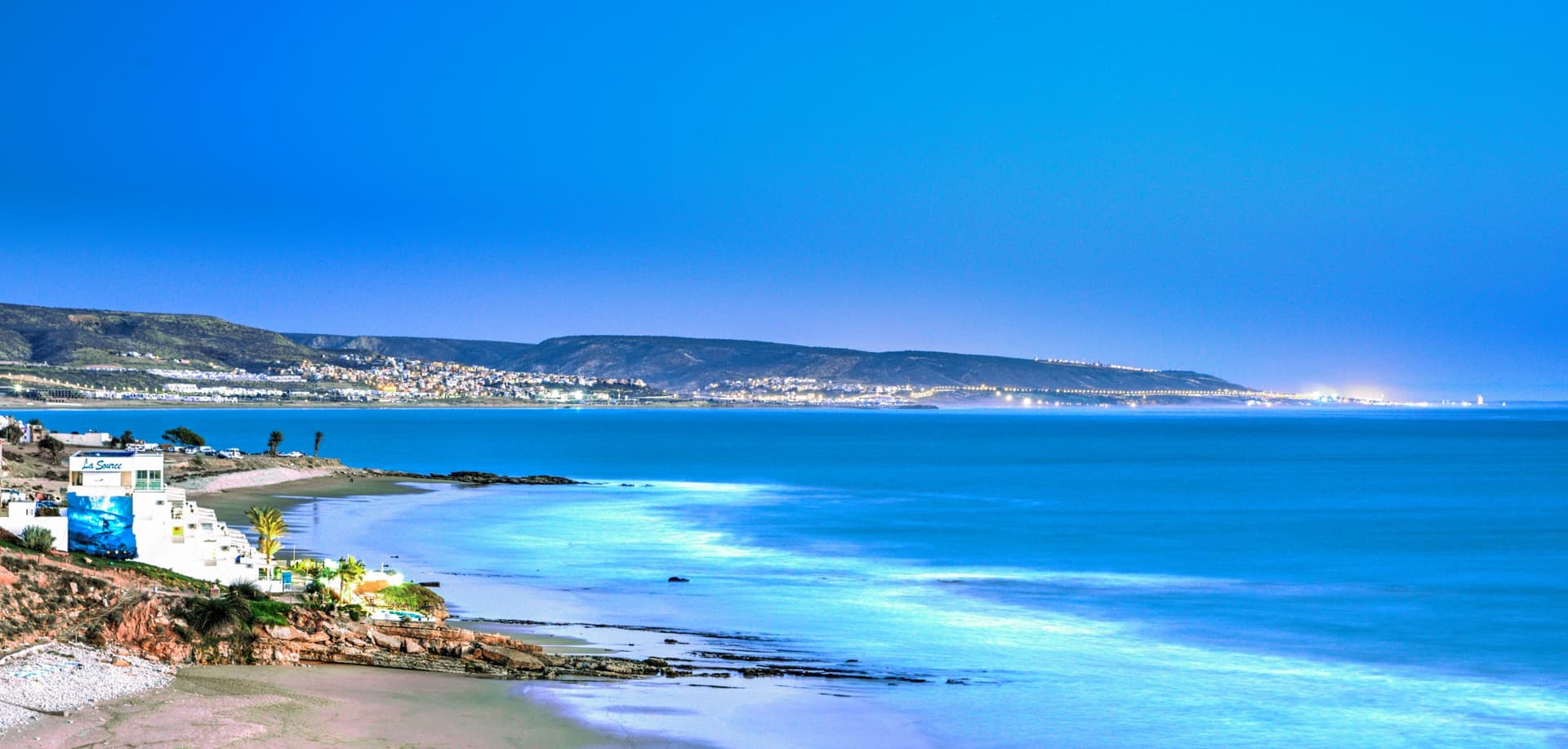
Golden beaches, nearly year-round sunshine, the Anti-Atlas as backdrop: Agadir combines seaside relaxation with access to southern Maroc.
Far from being a purely traditional Moroccan city, Agadir is widely renowned for its beach and fine sand, and as one of Maroc's premier beach destinations. Beyond its whitewashed seafront, Agadir welcomes countless visitors each year and reveals its charm through lush gardens and flowered public spaces.
The History of Agadir
The name Agadir derives from an Amazigh word of Phoenician origin, meaning "communal granary or fortified village". Indeed, the Souss region is dotted with fortified granaries that villagers built to protect against pillaging during invasions. Historical records are sparse about Agadir before the 12th century, when historian Polybius made reference to a cape called "Rhyssadir," in northern Africa near the Atlantic. This location may have been situated not far from present-day Agadir. The earliest documented reference to Agadir appears on a 1325 map, which marks a place called Porto Mesegina, named after the Berber tribe Mesguina, already mentioned in the 12th century.
The early 16th century saw the arrival of the Portuguese in Agadir. They established a trading post and fortress dedicated to rapidly developing fishing activities. To secure the settlement, Portuguese king Manuel I expanded the port, established a garrison, and brought the region under Portuguese authority in 1513. Agadir became an active trading hub where goods from southern Maroc passed through, and a meeting point for European merchants of all nationalities. In 1541, the Saadian Sharif Mohammed ech Cheikh seized the fortress and the Portuguese governor's daughter, precipitating the Portuguese withdrawal from Moroccan territory.
Events unfolded in succession: the prestige of the Saadian dynasty and the birth of the kasbah, its decline and first destruction, the protectorate period—until an earthquake devastated Agadir on February 29, 1960. This natural disaster destroyed or severely damaged nearly 95% of Agadir's infrastructure, not to mention significant loss of life. To restore the city's character, French architects took the initiative to rebuild the kasbah and port of Agadir while preserving their authenticity.
Exploring Agadir
The Moroccan city of Agadir is home to approximately 600,000 residents and lies in the southwest of Maroc. Nestled on the Atlantic coast in the Souss region, Agadir ranks among Maroc's principal urban centers. With 300 days of sunshine per year, Agadir charms with an expansive beach stretching some 6 kilometers. Despite the earthquake that ravaged the city in 1960, Agadir was almost entirely rebuilt. Through its agriculture and coastal position, the Moroccan city developed an exceptional port. This makes Agadir Maroc's leading fishing port as well as an important economic hub. It boasts several ports: a major port with a recently renovated marina and a large commercial port. Thanks to its year-round mild climate, beaches, and exceptional bay, Agadir stands among Maroc's most welcoming and tourist-friendly cities.
Yet Agadir, somewhat removed from typical Moroccan culture, doesn't offer conventional tourist activities. Instead, its magnificent bays allow for scenic excursions under abundant sunshine, water-skiing, diving, or sampling fresh fish in the many restaurants along Agadir's port. Downtown Agadir features several squares such as Place de l'Espérance and Place des deux Fontaines, which extend into a spacious green area developed by the municipality. Along the waterfront, Agadir offers numerous amenities allowing you to enjoy the seafront across approximately five kilometers.
Moreover, Agadir's oldest quarter, La Casbah, perched on a hillside, offers sweeping views over the fishing port. The traditional Moroccan neighborhood charms with its narrow, bustling streets, authentic architecture, and the aromas of distinctly Moroccan dishes and their aromatic spices.
What to Do in Agadir
Those seeking to relax under Agadir's sun won't miss its magnificent beaches. The city is indeed Maroc's finest beach destination. To add spice to your getaway, you can even arrange a camel ride on the beaches.
The region also offers water sports activities. You can choose between windsurfing lessons or a jet-ski session. Surf enthusiasts need only head to the beaches of Taghazout.
Birdwatchers will find satisfaction exploring the Valley of the Birds, where they can observe several lesser-known bird species including ostriches and numidian cranes. Beyond serving as a wildlife reserve, this area immerses you in exotic scenery amid banana palms, magnolias, bougainvilleas, and other typical trees.
For cultural discovery, don't miss the city's iconic museums showcasing traditional Moroccan objects. Specializing in Moroccan art, Tiskiwin Museum reveals an extensive collection of historic Moroccan artifacts from the Saharan region and Souss valley. Meanwhile, the Amazigh Heritage Museum will captivate you with its sumptuous collections of jewelry, talismans, carpets, pottery, and numerous other items relating to Berber life.
To discover traditional Moroccan architecture, don't overlook the kasbah, located at elevation 236 meters above sea level. This site first offers breathtaking panoramas of the entire city and Agadir's ports. It is a fortress built in 1560 to protect the city from Portuguese attacks.
Finally, to encounter the local population, don't miss the medina, Agadir's old town, which houses structures representative of traditional Moroccan architecture. The neighborhood recreates all the characteristics of Moroccan medinas with its winding streets and bustling souks. Souk El Had is the ideal place to purchase souvenirs.
Climate
In Agadir, rainfall can be heavy and cause flooding depending on the year. According to experts, annual precipitation totals approximately 250 millimeters. Typically, a few rainy days occur between November and March. This is why Agadir experiences more than 340 days of sunshine annually. However, morning mist and dew do occur in summer. Temperatures are strongly influenced by trade winds, but the arrival of Saharan air masses, the chergui, can push temperatures above 40°C. With its desert climate, Agadir is visitable year-round.
Agadir lies very close to Europe—just 14 kilometers separate it from Spain across the Strait of Gibraltar. Travelers can thus seek the most original ways to reach this magnificent beach destination. First head to Spain, then take a car-ferry bound for Agadir. Alternatively, the city has an international airport: Agadir Al-Massira, served by all major international airlines departing from major capitals.
Tourists already in Maroc need only opt for domestic flights to reach Agadir. The city is accessible from Marrakech, Casablanca, and other major Moroccan cities. All Moroccan regions are also connected by national roads that facilitate travel throughout this North African country.
Bus:
It is the most common form of public transportation in Agadir. One company operates the urban network in the city. Tickets are purchased on board, with fares varying by destination. The minimum fare for a downtown trip is 3 dhs.
Taxi:
There are two categories of taxi in Agadir, as throughout Maroc:
- Small taxis operate only within urban zones and all have meters. Upon pickup, the meter should display 2.00 dhs during the day. However, a 50% surcharge applies to evening trips.
- Large taxis can travel any distance. They have no meters, so you must agree on the fare before departing. You'll find this type of taxi at the bus station, airport, or by phone order.
Two-Wheelers:
Solo travelers can rent a bicycle or scooter. You'll find several rental agencies on Avenue Mohamed V.
Want to discover this destination?
Our local advisors design your tailor-made trip.