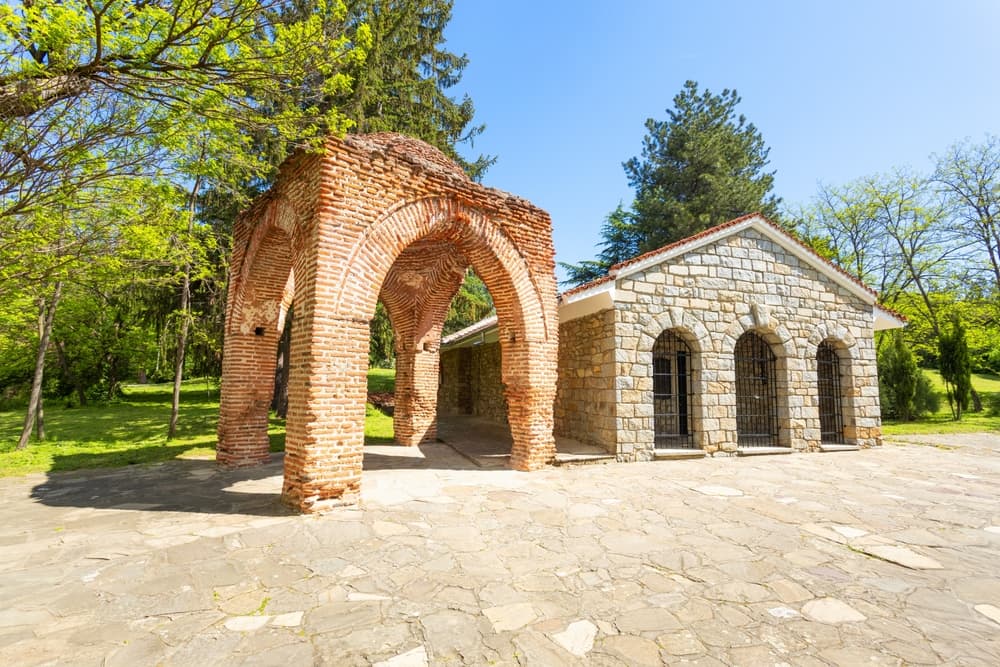
Thracian Tomb of Kazanlak
Thracian Tomb of Kazanlak
At Kazanlak, the 4th-century BCE Thracian tomb houses funerary frescoes among the most remarkable of ancient Balkan antiquity, inscribed on the UNESCO World Heritage list since 1979.
At Kazanlak, in the heart of Bulgaria's Valley of the Roses, lies one of the world's best-preserved Thracian funerary monuments. Dating from the 4th century BCE, this tomb has been inscribed on the UNESCO World Heritage list since 1979. Its interior frescoes, still vibrant in colour, depict a funeral feast and cavalry scenes that rank among the most precious testimonies of ancient Thracian art.
Essential Information at a Glance
- Access: The original tomb is closed to the public to preserve the frescoes; a full-scale replica is accessible a few hundred metres away.
- Recommended duration: 30 to 45 minutes for the replica and site.
- Dress code: No specific requirements.
- Accessibility for disabled visitors: Limited due to terrain and access stairs to the replica.
What You'll See
The original tomb consists of an entrance corridor (dromos), an antechamber, and a circular burial chamber covered by a brick dome. The frescoes adorning the dome depict a Thracian couple—likely a king and his wife—seated at a banquet, surrounded by servants, musicians, and galloping cavalry. The rendering of faces and drapery testifies to rare painterly mastery for the era.
The replica faithfully reproduces the architecture and paintings, allowing visitors to appreciate the details without risking damage to the originals.
History and Context
The tomb dates from the late 4th or early 3rd century BCE, a period of flourishing Thracian civilisation in the Balkans. It belongs to the Seuthopolis necropolis, capital of the Thracian king Seuthes III. Discovered in 1944 during excavation work, it revealed an exceptional state of preservation. UNESCO inscribed it on the World Heritage list in 1979, recognising the universal significance of its funerary art.
Highlights of the Visit
The Dome Frescoes
The circular ceiling of the burial chamber is entirely painted. The main frieze shows the deceased and his wife facing one another in a symmetrical, solemn composition. The pigments—ochre, red, black, white—have survived more than two millennia with remarkable intensity.
The Frieze of Cavalry
In the entrance corridor, a procession of mounted warriors frames the central scene. The movement of the horses and the precision of the armour illustrate the skill of Thracian artists, likely trained in the Hellenistic tradition.
Kazanlak History Museum
Nearby, the museum displays objects from regional excavations: gold jewellery, ceramics, and Thracian weapons that usefully complement your tomb visit.
Photography Tips
Photography is permitted in the replica. The artificial lighting is soft but uniform; a wide-angle lens captures the entire dome. Avoid flash, which can distort the colours of the reproduced frescoes. Since the original tomb is closed, no photography is possible there.
Location and Access
The site is located in Tyulbeto Park, on the northern edge of Kazanlak's city centre. The town is accessible by train or bus from Sofia (approximately 200 km) and Plovdiv. From Kazanlak's centre, the park is reachable on foot or by taxi. Parking is available at the park entrance.
Kazanlak is the ideal starting point for exploring the Valley of the Roses and the many Thracian tumuli in the region.
Nearby Attractions
- Valley of the Roses — The Kazanlak basin concentrates the majority of Bulgaria's rose-oil fields, spectacular in May-June.
- Thracian Tomb of Shipka — Another major Thracian funerary monument, a few kilometres to the north-west.
- Shipka Pass — Site of the Russo-Turkish battle of 1877-1878, with a memorial and panoramic views over the Balkans.
- Shipka Monastery — Russian memorial church with golden domes, erected in memory of those who fell at the pass.
Frequently asked questions
No. The original tomb is closed to the public to protect the frescoes from fluctuations in humidity and temperature. Only the full-scale replica, built nearby, is open to visitors.
The tomb is open year-round. If you wish to combine the visit with rose blooms, choose late May or early June, when the Kazanlak Rose Festival takes place.
Allow 30 to 45 minutes for the replica and Tyulbeto Park. Adding the Kazanlak History Museum, plan for a full half-day.
Yes, in the replica. Flash is not recommended, as it can distort the perception of colours. Since the original tomb is inaccessible, the question does not arise for it.
The Kazanlak region contains several Thracian tumuli. The Shipka tomb and Kazanlak museum make for a coherent day trip. Shipka Pass and its monastery can be easily added in the afternoon.
Interested in this visit?
We can include it in your personalised itinerary.