Bahia Palace
Bahia Palace
In the south-east of Marrakech's medina, the Bahia Palace unfolds across 20 hectares of courtyards, gardens and 19th-century Arabo-Andalusian décor.
In the south-east of Marrakech's medina, the Bahia Palace stretches across paved courtyards, secluded gardens and sculpted cedar ceilings spanning some twenty hectares. Its name means "brilliance" in Arabic, a tribute to the favourite wife of the grand vizier who completed it in the late 19th century. It remains one of the rare Moroccan palaces of this era open to the public.
Why visit the Bahia Palace
The palace offers a comprehensive showcase of late 19th-century Arabo-Andalusian architecture: polychrome zellige tilework, carved stucco, Carrara marble, hand-painted cedar ceilings. Unlike many historic Moroccan residences, it is easy to navigate and remains partially furnished in its original décor.
The site presents three main attractions:
- A cohesive ensemble of 150 rooms, salons and courtyards spread across 20 hectares;
- A rich history spanning from grand vizier Ba Ahmed through General Lyautey to King Mohammed V;
- A central location, just a short walk from the Mellah, El Badi Palace and Jemaa el-Fna square.
A history of power and succession
Construction of the palace was commissioned in 1859 by Si Musa, grand vizier to the sultan, and completed by his son Ahmed bin Musa, known as Ba Ahmed, who himself became grand vizier to the young sultan Abdelaziz. Ba Ahmed made it his residence with his four wives and gave the palace its name, "Bahia".
For the décor, the vizier summoned the finest craftsmen from Maroc and imported marble and gypsum from Italy, paid for in Moroccan sugar. Part of the marble actually came from closer to home: transported from Meknès, it originated from the El Badi Palace, stripped a century earlier by sultan Moulay Ismaïl to construct his own capital.
Upon Ba Ahmed's death in 1900, an additional storey was added. In 1912, under French protectorate rule, General Hubert Lyautey established his headquarters there and equipped the building with electricity, telegraph and telephone services. Following independence in 1956, King Mohammed V made it his Marrakech residence. Hassan II subsequently entrusted the site's management to the Ministry of Culture, which opened it to the public. The royal family continues to host visiting dignitaries there, which may occasionally result in closures.
The palace on screen
The palace's courtyards and salons have served as a backdrop for several films, including Lawrence of Arabia by David Lean and A Hundred Thousand Dollars in the Sun by Henri Verneuil, as well as numerous Arab productions.
What to see on site
The visit follows an open route through several distinct areas, organised around patios and gardens.
The Small Riad
The first area after the entrance, the Small Riad comprises a secluded garden surrounded by three salons. The painted wooden ceilings and carved stucco are particularly well preserved here. One of the salons opens onto the grand courtyard.
The grand marble courtyard
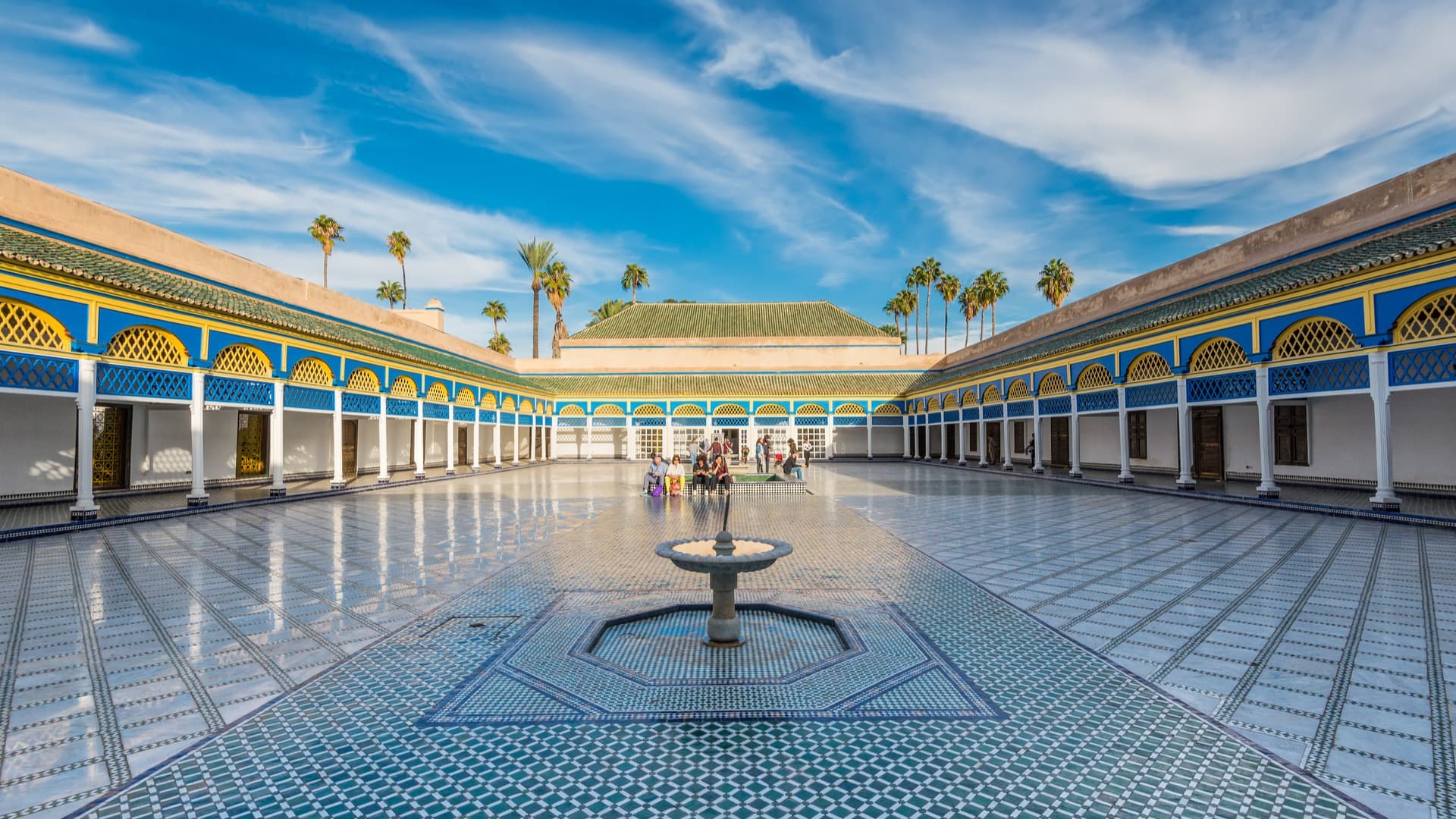
Paved with white Carrara marble, this rectangular courtyard is surrounded by covered galleries. A fountain marks its centre, and the gallery walls are adorned with blue and yellow zellige tilework. This is the most photographed area of the palace.
The Grand Riad
On the other side, the Grand Riad dates to Si Musa's era. Its garden features orange trees, jasmine and banana plants, around which are arranged apartments with sculpted cedar ceilings. This section once connected to the harem and private quarters.
Annexes
The complex also includes a mosque, a hammam and former stables. Most rooms are unfurnished: after Ba Ahmed's death, the furniture was dispersed among his wives, the sultan and his entourage. The focus of a visit centres on the architecture and décor.
Practical information
- Address: Rue Riad Zitoun El Jedid, south-east of Marrakech's medina, near the Mellah.
- Access: on foot from Jemaa el-Fna square (approximately 10-15 minutes) or by petit taxi to the street entrance, as the palace is in a pedestrian zone.
- Duration of visit: allow 1 to 1.5 hours to explore at a leisurely pace.
- Admission fee: paid entry at moderate rates, payable on-site. Verify current conditions before your visit.
- Guide: few explanatory panels on-site. An English-speaking accredited guide helps contextualise the history and decorative details.
When to visit
The palace is open year-round, but may close without notice during royal visits or official ceremonies. To enjoy the site in ideal conditions:
- Early morning, from opening time: the light is soft on the zellige work and crowds remain limited. This is the best time for photography.
- Seasons: spring (March-May) and autumn (October-November) offer the most pleasant temperatures. In summer, visit in the morning to avoid heat in unshaded courtyards.
- Crowds: the palace features on most group itineraries and can be very busy mid-day.
What to see nearby
The palace's location allows you to visit several major sites in the southern medina:
- The Mellah, the former Jewish quarter, just a few streets away, with its synagogue and spice market;
- the El Badi Palace, monumental 16th-century ruins that supplied much of the Bahia's marble;
- the Saadian Tombs, rediscovered in 1917, within easy reach;
- Jemaa el-Fna square, approximately 10 minutes' walk to the north.
To extend your journey beyond Marrakech, the Ksar Aït Benhaddou and Kasbah de Taourirt showcase another facet of Moroccan architecture, on the south side of the Atlas.
Frequently asked questions
Frequently asked questions
One to one and a half hours are sufficient to explore the main courtyards, the Small Riad and the Grand Riad. Allow more time if accompanied by a guide or if you wish to photograph the details.
It is open daily, but may close occasionally during visits from the royal family or dignitaries hosted on-site. It's best to check the day itself.
It's not mandatory, but worthwhile: signage on-site is limited and the palace's history—from the grand viziers through the protectorate—merits explanation to understand the architectural and decorative choices.
Very little. After Ba Ahmed's death in 1900, the furniture was dispersed. The visit focuses on architecture, zellige work, stucco and painted ceilings, as well as the gardens.
It's a 10 to 15-minute walk along Rue Riad Zitoun El Jedid, which descends towards the south-east of the medina to the palace entrance.
Plan your stay
The Bahia Palace fits naturally into a circuit through Marrakech's southern medina, complementing the Mellah, the Saadian Tombs and El Badi Palace. To build a tailor-made itinerary including Marrakech and other regions of the kingdom, explore our journeys through Maroc.
Interested in this visit?
We can include it in your personalised itinerary.