Ben Youssef Medersa
Ben Youssef Medersa
A former Quranic university in the heart of Marrakech's medina, Ben Youssef Medersa stands out for its zellige tilework, sculpted cedarwood, and courtyard with reflecting pool.
The Ben Youssef Medersa, a former Quranic university nestled in the heart of Marrakech's medina, ranks among Morocco's finest examples of Islamic architecture. Reopened in April 2023 after years of renovation, it draws visitors for its zellige tilework, intricately carved cedarwood ceilings, and the basin-centred courtyard that forms its soul.
Why visit Ben Youssef Medersa
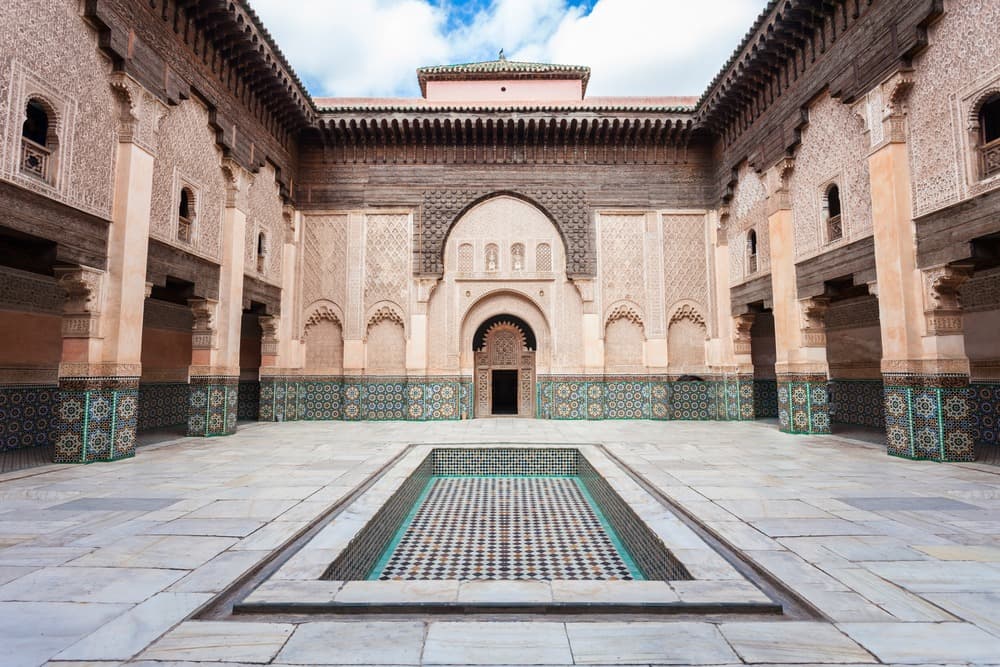
The building once functioned as one of North Africa's largest theological schools. Its modest façade, blending into the medina's ochre fabric, gives little hint of the ornamental richness within: marble, stucco, zellige, and carved wood compose a harmonious décor that bears striking parallels to the Alhambra in Granada. Scholars have plausibly suggested that Andalusian artisans were enlisted for this Saadian undertaking.
The site's appeal extends to its atmosphere: despite the souks' immediate proximity, the medersa's high walls filter out the bustle and preserve an unexpected serenity.
History
Ben Youssef Medersa was constructed in Marrakech during the 14th century under the Marinid sultan Abu al-Hassan. It takes its name from the adjacent Ben Youssef Mosque, erected two centuries earlier. Originally modest in scale, the building was entirely reconstructed in the 16th century under the Saadian dynasty by sultan Abdallah al-Ghalib. Work was completed in 1565, establishing the medersa as one of the region's foremost theological universities.
Over the centuries, approximately 900 students resided within its walls simultaneously, distributed across 130 cramped dormitory cells. The college ceased functioning in 1960, was restored and opened to the public in 1982, then underwent a second major renovation campaign beginning in November 2018, culminating in its spring 2023 reopening.
What to see on site
The entrance and its inscription
The wooden portal and bare walls reveal little of what lies beyond. Above the threshold, an Arabic inscription welcomes visitors: "You who enter here, may your greatest hopes be exceeded." Originally addressed to students, this phrase today welcomes all who visit.
The courtyard with reflecting pool
The central courtyard forms the building's beating heart. A rectangular marble basin mirrors the arcades, the carved cedarwood of the galleries, and a slice of sky. The walls combine geometric zellige, Kufic calligraphy, and chiselled stucco in a Hispano-Moorish ornamental vocabulary.
The prayer hall
Beyond the courtyard, sheltered beneath two columned arcades, the domed prayer hall concentrates the densest decoration: zellige flooring, wall calligraphy, and a stucco ceiling adorned with unusual motifs such as pinecones and palm trees. The acoustics are remarkable: words spoken at normal volume carry throughout the chamber, a feature particularly useful for collective instruction.
Student dormitory cells
On the upper floor, former student cells offer stark contrast to the communal spaces: sober décor and intimate proportions. The windows adorned with sculptured vine motifs overlook the courtyard and offer some of the site's finest vantage points.
Practical information
- Address: Ben Youssef Square, Marrakech medina, near Ben Youssef Mosque and Marrakech Museum.
- Admission: modest entrance fee with discounts for children. Tickets purchased on-site.
- Visit duration: allow 45 minutes to 1.5 hours depending on your interest in ornamental detail.
- What to bring: appropriate dress; shoes easy to remove if certain areas require it.
With a bit of luck, you may encounter a calligrapher in the courtyard painting names in Arabic script for a few dirhams.
When to visit
The medersa welcomes visitors year-round, but morning at opening time remains ideal: low-angle light emphasizes the relief of the stucco and the basin's reflections, while crowds are thinner than at midday. Late afternoon also bathes the woodwork in warm, flattering light.
Seasonally, October–November and March–April offer Marrakech's most comfortable temperatures. In summer, the medersa provides a welcome coolness after time spent in the medina's heated alleyways.
How to get there
The medersa sits on Ben Youssef Square in the medina's northern reaches. Several routes are possible:
- From Jemaa el-Fna Square, heading north through the souks (15–20 minutes on foot).
- From the souks via Bab Talar or Bab Kcheiria.
- From the city's east side through the tanners' quarter at Bab Debbagh.
- From Moukef Square, following the main street leading directly to the site.
Since alleyways are not always signposted, an offline mapping app greatly aids navigation.
Nearby attractions
- Bahia Palace: another masterpiece of Moroccan decorative art, in the medina's southern quarter.
- Bou Inania Medersa: the Marinid counterpart in Fès, useful for comparing two generations of Quranic schools.
- Marrakech: comprehensive guide to the city and its quarters.
Frequently asked questions
Frequently asked questions
Yes. After several years of renovation beginning in November 2018, the medersa reopened in spring 2023 and welcomes visitors daily.
Plan for an average of 45 minutes to 1.5 hours. Visitors with particular interest in calligraphy and zellige often linger longer.
Yes, the prayer hall is accessible to visitors, as the medersa is no longer an active place of worship. Appropriate dress is recommended.
Advance booking is not necessary; tickets are purchased on-site. During peak season, arriving at opening time helps you avoid the crowds.
The Bou Inania Medersa in Fès dates from the Marinid period (14th century), whereas Ben Youssef Medersa as we see it today results from a Saadian reconstruction in the 16th century. Both buildings share the same ornamental vocabulary but differ in scale and layout.
Including the medersa in a Morocco itinerary
Ben Youssef Medersa naturally integrates into a circuit through Marrakech's medina alongside Bahia Palace, the Saadian Tombs, and the souks. To build a custom itinerary featuring Marrakech and other imperial cities, explore our Morocco journeys.
Interested in this visit?
We can include it in your personalised itinerary.