Black Sea Coast
378 kilometers between limestone cliffs in the north and fishing villages in the south, dotted with Byzantine churches, pelican lagoons, and tables of grilled fish.
Bulgaria's Black Sea coast stretches for 378 kilometers, from the Romanian border in the north to the Turkish border in the south. Our team divides it into two distinct regions: the northern coast around Varna, more mineral in character, with its limestone cliffs and steppe plateaus that plunge into the sea, and the southern coast from Burgas onward, more heavily forested, where the foothills of the Strandzha descend toward sandy bays fringed with pines. This geography shapes everything: agriculture, fishing, urban planning inherited from the socialist era, and the rhythm of summers.
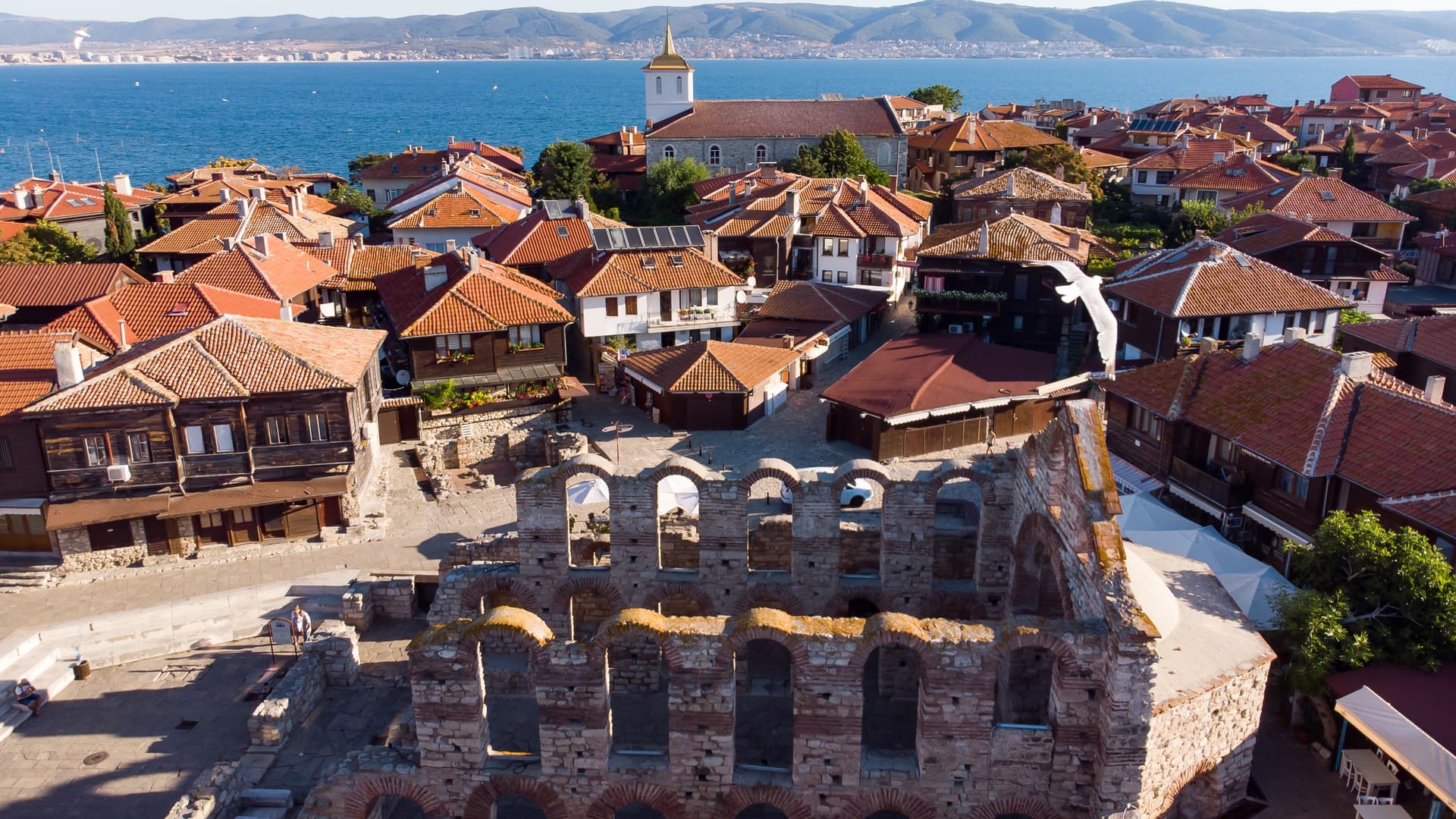
Varna, the country's third-largest city with 330,000 inhabitants, concentrates the region's archaeological heritage. Its museum presents the Chalcolithic necropolis dated from 4600 to 4200 BCE—the oldest known worked gold treasure to date. An hour's drive to the south, Nessebar sits on a peninsula connected to the mainland by a 400-meter isthmus. The old town, a UNESCO World Heritage site since 1983, preserves about forty Byzantine and medieval churches within less than a square kilometer, including Saint Stephen and Christ Pantocrator, with facades of brick and glazed ceramics characteristic of the Constantinople school.
Further south, Sozopol retains the character of an ancient Greek port, founded as Apollonia Pontica in the 6th century BCE. The houses of the old town, with stone ground floors and dark wood upper stories in corbeled fashion, date from the 18th and 19th centuries. This is where Bulgarians from Sofia and Plovdiv have spent their summers since the 1920s, and the Apollonia arts festival, held in early September, continues this cultural tradition. Between Sozopol and the Turkish border, the coast becomes wilder: the villages of Ahtopol, Sinemorets, and Rezovo provide access to beaches that the main road does not reach directly.
The hinterland deserves exploration. The Ropotamo delta, 50 kilometers south of Burgas, is a freshwater fjord stretching 25 kilometers through a gallery forest of oaks and ash trees; boat trips allow you to observe pygmy cormorants, herons, and white water lilies. Cape Kaliakra to the north is a tongue of red limestone extending two kilometers into the sea; its 70-meter cliffs sheltered the Mediterranean's only permanent colony of monk seals, observed until the 1990s—today it's a prime spot for watching common dolphins and witnessing black stork migration. Lake Pomorie, a brackish lagoon between Burgas and Nessebar, welcomes curly pelicans and greater flamingos in spring and autumn.
Coastal cuisine stands apart from the rest of the country. Grilled fish dominates: horse mackerel, mullet, turbot when the season permits (October to March). Burgas fish soup, rybena chorba, is prepared with a minimum of seven species according to local purists. Mussels from Dalboka, farmed on ropes north of Kavarna, are served steamed in Khan Krum white wine, the local varietal from the eastern wine region, which produces dry white wines from Chardonnay and Dimyat.
In summer, the coast transforms. Sunny Beach, a resort built from 1958 onward north of Nessebar, welcomes up to 250,000 visitors per day in peak season, primarily from Germany, Romania, and the United Kingdom. This concentration is why we direct our travelers toward the southern villages or the northern fringes, where tourism remains at a Bulgarian scale.
Must-see
Nessebar's old town. Forty medieval churches on a peninsula of one square kilometer, best explored early in the morning before the tour buses arrive from nearby Sunny Beach.
Sozopol and the southern coast. Dark wooden houses from the 19th century clinging to cliffs, then the road toward Ahtopol and Sinemorets where the Veleka meets the sea in a lagoon bordered by fine sand.
Boat trip on the Ropotamo. An hour's journey by boat on this freshwater fjord flowing through protected gallery forest, among white water lilies and grey herons.
Cape Kaliakra and dolphin watching. Two kilometers of red limestone promontory plunging into the sea, an observation point for common dolphins and black stork migration in September.
Varna's gold treasure at the archaeological museum. Over 3,000 gold objects dated from 4600 to 4200 BCE, from the Chalcolithic necropolis excavated in 1972 on the city's edge.
When to go
We recommend June and September. In June, the water reaches 21-22°C and the air averages 25°C, with Nessebar and Sozopol accessible without crowds. September offers water still at 23°C through about the 20th, air temperatures around 26°C, and the golden light of late summer on the limestone cliffs. May remains cool for swimming (water at 17-18°C) but is perfect for hiking in the Strandzha and birdwatching. October brings returning rains, especially on the southern coast, and most seasonal restaurants close after the 15th.
July and August combine every drawback: temperatures of 30 to 33°C, peak crowds between July 15 and August 20 (Sunny Beach, Albena, Golden Sands are saturated), and accommodation prices doubled or tripled on the central coast. Winter, from December to March, holds little tourist appeal along the coast except for fish dining: cold northeasterly winds, temperatures of 2 to 8°C, almost all establishments closed outside of Varna and Burgas.
Practical advice
Allow 4 to 6 days for the coast alone, concentrating your stay on the Burgas-Sozopol-Ahtopol stretch in the south, plus one day for Nessebar and possibly two days on the Varna-Kaliakra-Balchik side in the north. Distances appear short on the map, but the single-lane coastal road over long sections slows travel: count on 2.5 hours between Varna and Burgas, and another 1.5 hours to reach Sinemorets. Varna and Burgas airports receive direct flights from several European capitals from April to October; outside this season, transit through Sofia is necessary, with 4.5 hours of driving or a one-hour domestic flight.
The coast combines naturally with Veliko Tarnovo and central Balkan (3 hours by road from Varna via mountain passes) for those wanting to pair sea with Bulgarian medieval heritage. A more complete circuit links Sofia, Plovdiv, the eastern Rhodopes, and descends to Burgas over 12 to 15 days. Comfort levels remain decent: family guesthouses in Sozopol and southern villages, renovated hotels in Varna and Nessebar, a few more contemporary options in Balchik. This region suits contemplative travelers willing to move around a bit, families with teenagers (warm sea, accessible archaeological sites), and birdwatchers outside peak season. Serious hikers will find more to do in the Rila or the Rhodopes.