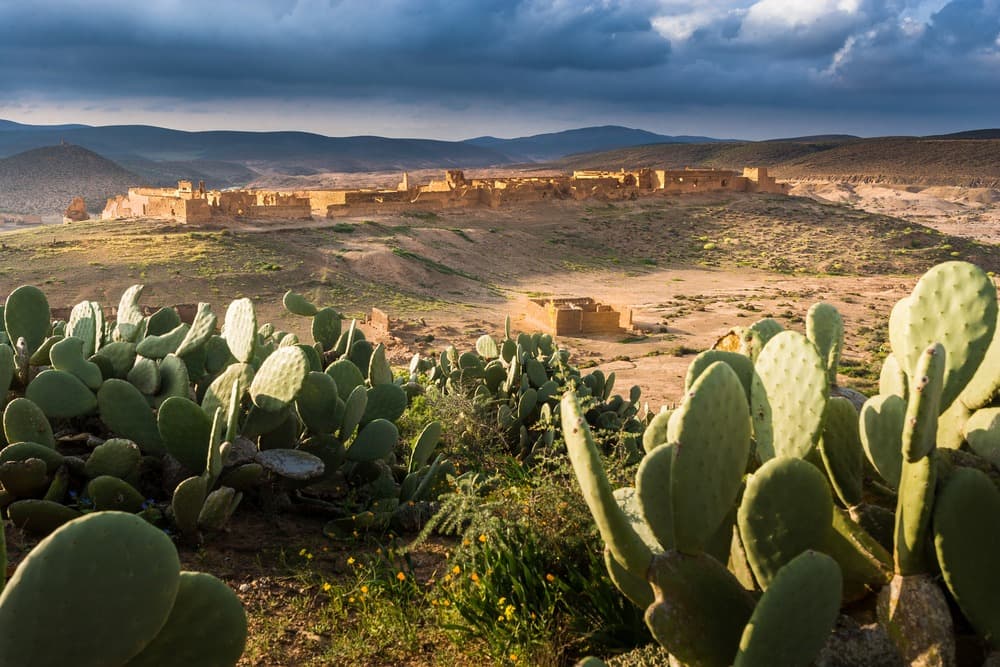
Fort Bou Jerif
Fort Bou Jerif
A former fort from the French protectorate built in 1935 near Guelmim, Fort Bou Jerif is a historic stop on the route through the Moroccan Sahara.
Fort Bou Jerif is a former military outpost of the French protectorate, perched in the heart of the presaharan desert in the Guelmim region, southern Morocco. Its ochre stone ruins, isolated in a landscape of rocky plateaus, bear witness to the history of French pacification at the edges of Rio de Oro. Today, the site is a valued stop for travellers heading toward the Sahara, midway between Sidi Ifni and Guelmim.
Why visit Fort Bou Jerif
The site combines three complementary interests: colonial military heritage still visible in its ruins, a setting of saharan isolation, and a practical stop on the southern Morocco itinerary. Unlike the touristy kasbahs of the Atlas, Bou Jerif has not been restored: you can read the wear of time and the harshness of its original context here.
The silence of the plateau, the quality of the night sky, and the scarcity of visitors make it a cherished pause for long-distance travellers, particularly those heading to Dakhla, Mauritania, or simply the southern Atlantic coast.
History of the fort
The Agadir-Confins military zone was created in early May 1934, under French protectorate rule. Its mission: to combat the raiders of Rio de Oro who threatened pacified territories or those allied to southern Morocco. To control this shifting frontier, the colonial administration had several forts erected at strategic points.
Fort Bou Jerif was built in 1935. It served as a border surveillance post with the Spanish enclave of Ifni, north of the Noun wadi. The initial garrison comprised cavalry troops, quickly replaced by méharistes—camel-mounted troops, better suited to the desert environment and the mobility required across such terrain.
The fort lost its military function after independence and the integration of Ifni into Morocco in 1969. Abandoned, it has since been partially eroded, but its main structures remain standing.
What to see on site
The fort ruins
Visiting the ruins is free and takes less than an hour. Several features deserve attention:
- The rainwater harvesting system, still visible, which testifies to the constraints of water self-sufficiency for an isolated garrison.
- The execution wall, where bullet marks can still be seen in the stone.
- The residential buildings and perimeter walls, which give an idea of the internal organization of the outpost.
The surrounding landscape
The fort overlooks a landscape of hamada (stony plateau) typical of presaharan Morocco. Sunsets there are long and the nights, in the absence of any light pollution, are particularly clear.
Practical information
An independent hotel-restaurant, bearing the name of the fort, is located in immediate proximity to the ruins. It offers several accommodation options:
- Hotel rooms
- Berber tents
- Bivouac spaces for campervans and personal tents
- On-site dining and swimming pool
Plan for approximately one hour to visit the ruins alone, or one night on site to enjoy the setting. Rates remain moderate compared to coastal establishments.
When to visit
The region has a Saharan climate: hot and dry in summer (June to August), with daytime temperatures frequently exceeding 35°C. The most comfortable period extends from October to April, with mild days and cool nights, sometimes cold in December-January. Spring (March-April) offers balanced conditions, ideal for combining sightseeing and a night under the stars.
How to get there
Access is generally from Sidi Ifni, a small coastal town south of Agadir, via a track requiring a 4x4 or off-road vehicle. The main route passes through Morocco via Tiznit, then takes the Lakhsas pass which peaks at 1,100 metres before descending toward the Souss plain.
From Guelmim, located roughly 200 km south of Agadir, allow one to two hours of track driving depending on terrain conditions. A regular car may suffice in dry weather, but a 4x4 remains recommended.
Nearby attractions
- Sidi Ifni: former Spanish enclave, art deco architecture, Atlantic beaches.
- Guelmim: gateway to the Sahara, famous for its weekly camel souk.
- Tiznit: rammed earth ramparts and Berber silver work.
- Legzira Beach: natural arches sculpted by the ocean, approximately one hour north of Sidi Ifni.
For travellers combining southern Morocco and the Atlas, the Dadès Gorges and the Bahia Palace in Marrakech form coherent complements when heading north.
Frequently asked questions
Frequently asked questions
A 4x4 is recommended, especially after rainfall. A regular car can reach the site in dry weather, but the track remains uneven on the final kilometres.
Yes. The Fort Bou Jerif hotel-restaurant, near the ruins, offers rooms, tents, and bivouac spaces. Reservations are advised in high season.
Access to the ruins is generally free. No official guide is attached to the site; visitors explore independently.
Allow one hour for the ruins visit, or one night on site to enjoy the sunset and night sky.
October to April, to avoid summer heat. March-April offers the most pleasant conditions for combining sightseeing and bivouacking.
Planning your itinerary
Fort Bou Jerif fits naturally into a southern Morocco itinerary combining Tiznit, Sidi Ifni, Guelmim, and the Atlantic coast. To build a coherent journey, consult our selection of itineraries at Morocco.
Interested in this visit?
We can include it in your personalised itinerary.